
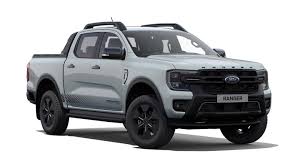
FORD RANGER
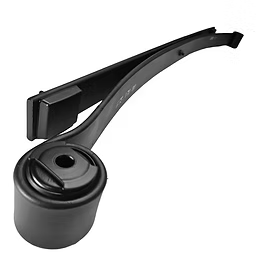
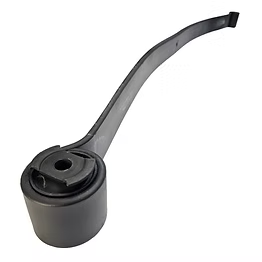
LEAF SPRING
REINFORCING KIT
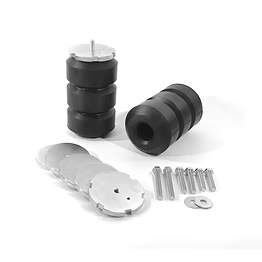
AUXILIARY SPRING

FORD RANGER
2012 ➞
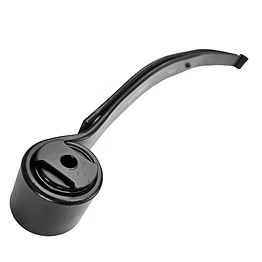
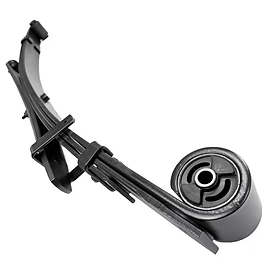
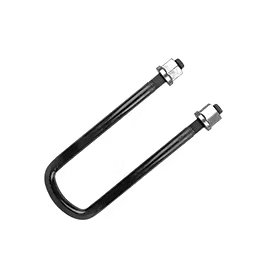
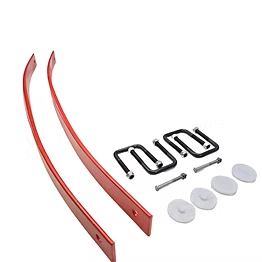
ONLINE INQUIRY
If you are not sure which of the many Ford Ranger leaf springs fits your vehicle, please submit your inquiry online and we will email you a quotation. If you find our quotation suitable, your product is just a click away.
WOULD YOU LIKE TO KNOW MORE ABOUT
FORD RANGER LEAF SPRINGS?
HERE ARE THE MOST COMMON
QUESTIONS AND ANSWERS
What are the functions of a leaf spring on my Ford Ranger?
Despite its name, a leaf spring serves multiple purposes. Its main function is to link the axle and chassis, making it a crucial component. Consequence: If the leaf spring, particularly the main spring leaf, is broken or missing, the axle is not properly fixed to the chassis. In extreme cases, the axle may even move out of position, causing the vehicle to lose control on the road.
The leaf spring is responsible for keeping the axle in the correct direction. As a result, if the leaf spring does not have the correct dimensions, or especially if there are leaf springs with different dimensions on the left and right sides, the axle will not be parallel and the vehicle's driving conditions will be negatively affected. For example, there may be excessive tire wear or the vehicle may pull to the left or right.
The leaf spring is a crucial component of the suspension system, which typically includes the following main parts:
- Leaf spring
- Shock absorber
- Bump stop
- Stabilizer bar (optional based on different models and axle load categories)
The suspension system is composed of these parts, which work together to maximize tire-road contact, provide stability and good handling, evenly support the weight of the vehicle, and ensure passenger (and cargo) comfort by absorbing and dampening shocks.
Why did the leaf spring break in my Ford Ranger?
Leaf spring breakages in Ford Ranger can have several causes, and it can be difficult to determine the exact root cause. However, the typical causes are listed below. Please note that these explanations are simplified for easy understanding. Leaf spring (suspension) technology and steel technology (metallurgy) are special sciences.
- Continuous overloading beyond the vehicle's capacity
- Intensive off-road usage and harsh driving conditions
- Corrosion from road salt and environmental factors
- Manufacturing defects or improper heat treatment
- Age-related metal fatigue after years of service
- Impact damage from rocks or road debris
- Improper installation or maintenance
Overall, if the leaf spring on your Ford Ranger is broken, you cannot blame yourself for any mistakes. However, you must purchase a new leaf spring as soon as possible.
Is it safe to drive a Ford Ranger with a broken leaf spring?
There are six main criteria to consider when deciding whether you can drive your Ford Ranger with a broken leaf spring:
- Where (in which position) did the leaf spring break?
- Is the leaf spring a single leaf or a spring pack with multiple leaves?
- If your spring has multiple leaves, which leaf is broken?
- Is your vehicle loaded or empty?
- Does your vehicle have a stabilizer bar?
- Are you willing to take a risk? (Consider the potential consequences of driving without a replacement.)
The most dangerous combination is when the single leaf (mono leaf) spring, or the main leaf of a spring pack, is broken between the axle and front fixing point, and the vehicle does not have a stabilizer bar. In this case, the vehicle's axle is not properly fixed to the chassis, and the leaf spring on the other side is under tension. As a result, the leaf spring on the other side may break at any time, causing the axle to unexpectedly move out of its proper position and potentially causing the vehicle to become uncontrollable. In such cases, the vehicle should be driven at a minimum speed and taken for urgent servicing.
Ford Ranger Suspension Upgrades
Heavy-Duty Leaf Springs
Upgraded leaf springs designed for increased payload capacity, perfect for work trucks and towing applications.
Progressive Rate Springs
Variable rate leaf springs that provide comfort when unloaded and firm support when carrying heavy loads.
Off-Road Suspension Kits
Complete suspension packages designed for enhanced off-road performance and durability in extreme conditions.
Importance of Proper Torque for Ford Ranger Leaf Spring U-Bolt Nuts
U-bolts are responsible for securely attaching the leaf springs to the axle, making them a crucial component. The nuts on the u-bolts must be tightened to a specific torque. Always refer to your vehicle's specifications for the correct torque. If the factory torque specification is not available, use our recommended torque for the 10.9 steel u-bolts we supply.
M8: 35 Nm
M10: 75 Nm
M12: 130 Nm
M14: 200 Nm
M16: 315 Nm
M18: 440 Nm
M20: 610 Nm
M22: 830 Nm
These values apply to U-bolt thread surfaces that are free of oil or grease. If the surface is lubricated, reduce torque by 10% to 15%.
U-bolts must be retightened after 1,000 km to 5,000 km.